Next Generation Sequencing
Next Generation Sequencing
contact: ludwig@univ-brest.fr
1. Variants
1.1. What is a Variant ?
1.1.1. Small sized Variations
- SNV: Single Nucleotide Variant (abusively simplified as SNP: Single Nucleotide Polymorphisme) AGTGTGC → AGTATGC
- Short indel: insertion or deleltion
- Insertion: AGTGTGC → AGTGACGCTGC
- Deletion: AGTGTGC → AGTC
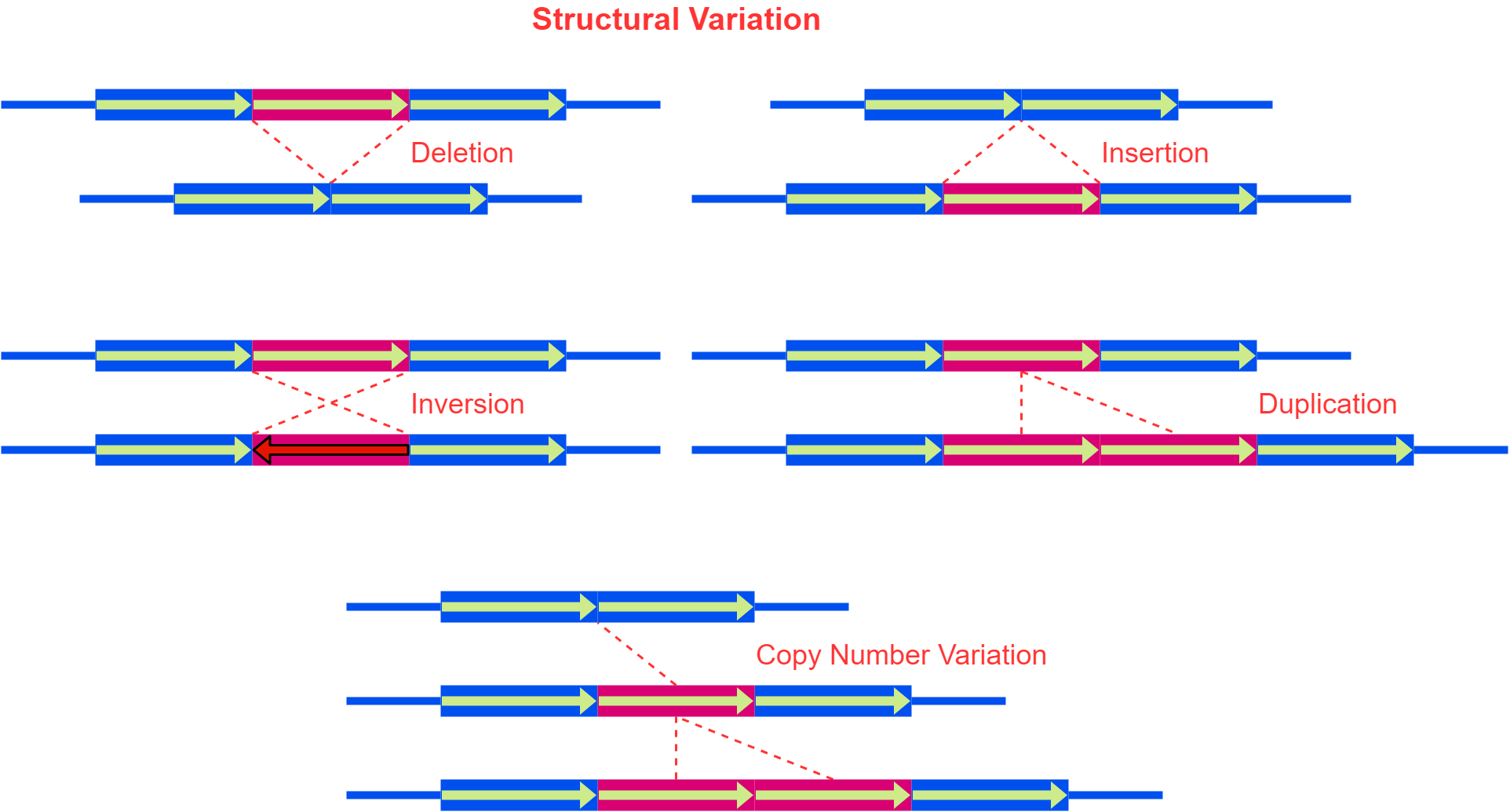
1.1.2. Structural Variantions
1.2. Why look at variants ?
- Identification (Genotyping, not Sequencing)
- Filiation
- Investigation
- Archeology
- Medicine
- Clinical diagnostics
- Cancerology
- Personalized Medicine
- Research
- Genetic Diseases
- Population Genetics
- Ancient DNA Studies
2. Sequencing Steps: from Biological Fragments to Numerical Reads
2.1. Library Preparation
- Amplification: Making copies of the DNA to sequence

- Fragmentation: Division in double stranded Fragments of different sizes
- Sonication
- Nebulization
- Enzyme Digestion

- Ligation: Extension of the Fragments with Double Stranded DNA Adapters (Oligonucleotides)
- Adapters allow for Hybridization to the flow Cell

- Denaturation: to get 2 Single-Stranded Fragments from 1 Double-Stranded Fragment

2.2. Amplification (multiple identical copy)
- Binding to the Chip (Hybridization to the Flow Cell) Either on 5' or '3' (pairing to the Adapters in the Flow Cell)

-
DNA Amplification by PCR: Production of the complementary strand from the Flow Cell Adapters

-
Denaturation: Strand not attached to the Flow Cell is washed away

-
Bridge Amplification: great number of cycles of PCR + Denaturation

-
Keeping only Single-Stranded Fragments corresponding to the forward strands

2.3. Sequencing By Synthesis
- Forward Strand is sequenced by synthesizing a complementary strand with marked nucleotides
- A light source excites the fluorescent marker and the emitted wave length is read
- This light emission is then converted to a base call
- A Bridge is formed again and this time, after denaturation, the forward Strand is washed away and the reverse strand is sequenced
- Image files are converted to text files (FastQ)
Conclusion
Sequencing takes biological Fragments as input and produces numerical Reads (or Read Pairs)

3. Workflow: From Reads to Variants
